What Is a Privacy-First Media Strategy for Video Ads?
Scott Konopasek··5 min read
Most brands still think a privacy-first media strategy is about compliance.
In reality, it’s about control.
As third-party cookies fade and accurately tracking consumers is harder, advertisers are forced to rethink not just how they target but where their video ads actually appear. This shift matters most in video, where attention is close, context is emotional, and brand risk is amplified.
In this guide, we explain what a privacy-first media strategy really means for video advertising today, why most approaches fall short, and how brands should be buying YouTube ads in 2026.
Why Privacy-First Media Buying Is No Longer Optional
1. Privacy Regulation Was the Trigger, Not the Finish Line
Privacy laws changed what advertisers can do with data, but they didn’t change why people stopped trusting ads. That shift came from audiences.
When a brand shows up next to unsafe, misleading, or low-quality content, people don’t separate the placement from the advertiser. They remember the experience, not the explanation. On YouTube, this effect is stronger. Ads play with sound and sit inside content that people actively choose to watch.
One bad placement can undo a lot of good work.
A privacy-first media strategy exists to prevent those moments before they happen. It’s not just about avoiding fines. It’s about protecting brand trust at the point where ads actually show up.
What is a Privacy-First Media Strategy?
A privacy-first media strategy is about buying media based on content, not people. For years, video advertising focused on who the viewer was and where they’d been online. That model is breaking down.
A privacy-first approach flips the question. Instead of asking, “Who is this viewer?” It asks, “What is this person watching right now?” That matters because video is contextual. The content sets the tone and the moment. Ads that fit feel natural. Ads that don’t feel intrusive. At a practical level, a privacy-first media strategy focuses on three things:
1. Context
Ads are placed based on the actual content being watched, not inferred interests or past behavior.
2. Placement quality
Channels are evaluated for relevance, tone, and overall quality, not just whether they pass a basic safety filter.
3. Transparency and control
Advertisers are aware of the locations of their advertisements and can thus take the appropriate actions regarding those placements based on the given information.
Why Video Advertising Changes the Privacy Conversation
1. Video Ads Are High-Attention and High-Risk
Unlike display or search ads, video ads:
Play with sound
Hold attention longer
Appear alongside emotionally charged content
That makes placement quality far more important. If a brand appears next to low-quality, misleading, or unsafe video content, the damage is immediate and memorable.
2. YouTube’s Scale Creates Hidden Placement Risk
YouTube offers unmatched reach, but scale introduces complexity:
Millions of long-tail channels
Constantly changing content
AI-generated and low-quality uploads
Kids and foreign-language content leaking into campaigns
Without a solid media strategy, brands often don’t realize where their ads ran until after the spend is wasted. At that point, the damage is already done.
Why Contextual Targeting Alone Is Not Enough
Contextual targeting is an important part of privacy-first advertising, but it does not solve the whole problem. Context alone does not guarantee that a placement is right for the brand.
Even within relevant categories, ads can still appear on:
Kids' content inside adult topic buckets
Low-quality or AI-generated videos
Foreign-language channels in English campaigns
Content that is technically on-topic but off-brand or misleading
Topic labels miss nuance. Algorithms can detect patterns, but they do not understand tone, intent, or brand values. That is why a YouTube media strategy has to go beyond surface-level context and include real judgment at the placement level.
How Different Media Buying Approaches Compare
Media Buying Approach
Uses Personal Data
Control Over Where Ads Run
Brand Suitability
Transparency
Behavioral targeting
Yes
Limited
Inconsistent
Low
Contextual targeting (AI-only)
No
Partial
Mixed
Medium
Privacy-first media strategy (human-verified)
No
Full
High
High
The Role of Human Verification in Privacy-First Media Buying
Automation plays an important role in video advertising. It helps manage scale and process large volumes of content. But automation alone cannot decide whether a placement is truly right for a brand. Algorithms are effective at identifying patterns and assigning categories. They are far less reliable when it comes to judgment.
AI works well for:
Sorting content into topics
Detecting obvious safety signals
Operating at scale across large inventories
AI struggles with:
Tone and intent
Subtle brand misalignment
Content that is technically relevant but low quality or misleading
In video advertising, those gaps matter. Context shapes perception, and a single poor placement can affect how a brand is remembered.
Why Human Verification Matters
Human verification adds the judgment layer that automation cannot replace.
It helps ensure that:
Channels meet brand suitability standards, not just basic safety rules
Content aligns with the intent of the campaign
Irrelevant or risky placements are removed before any spend occurs
In a privacy-first media strategy, human verification is not an optional enhancement. It is the safeguard that makes contextual targeting dependable, reduces wasted spend, and protects brand reputation at scale.
What a Safe YouTube Campaign Looks Like
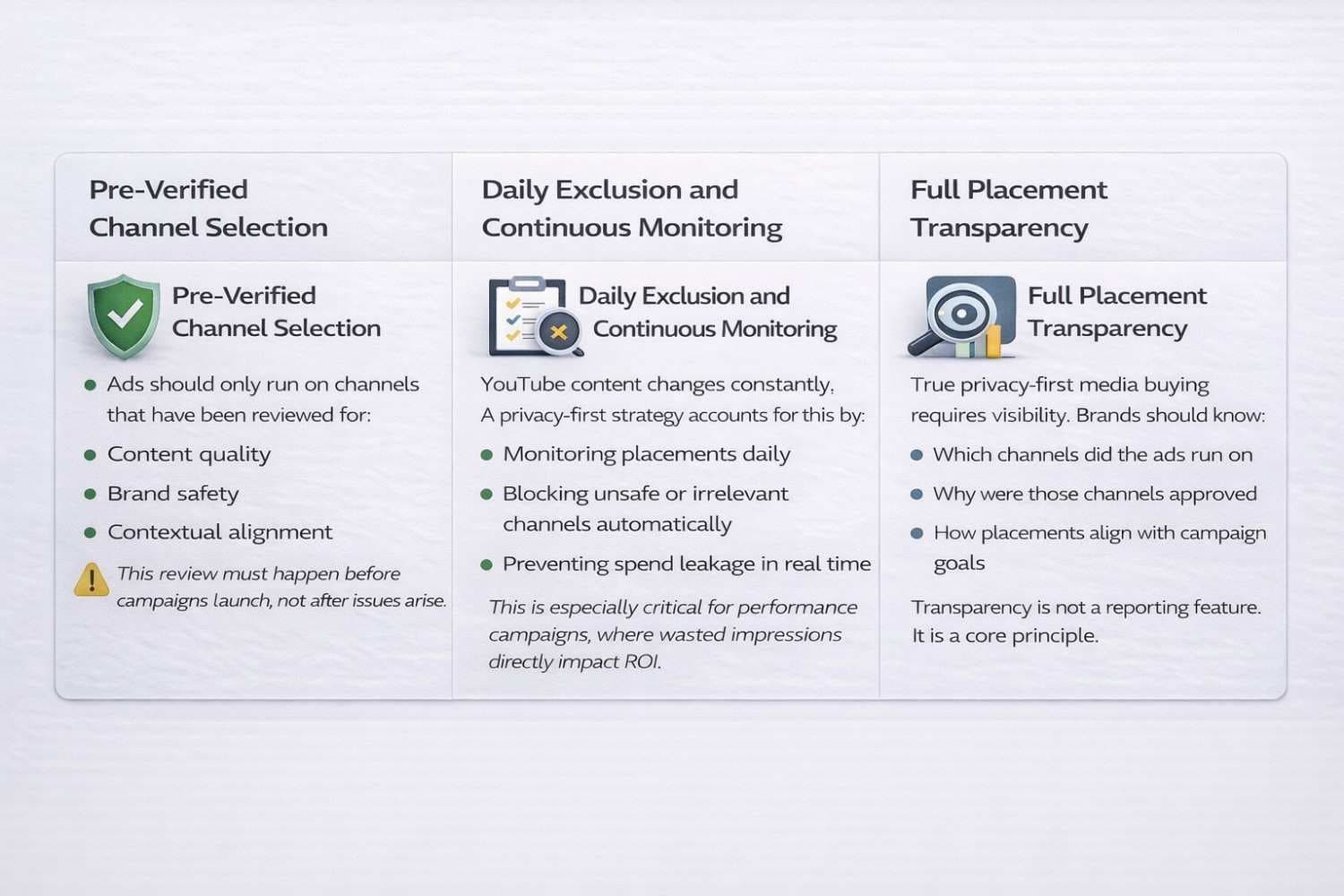
1. Pre-Verified Channel Selection
Ads should only run on channels that have been reviewed for:
Content quality
Brand safety
Contextual alignment
This review must happen before campaigns launch, not after issues arise.
2. Daily Exclusion and Continuous Monitoring
YouTube content changes constantly. A privacy-first strategy accounts for this by:
Monitoring placements daily
Blocking unsafe or irrelevant channels automatically
Preventing spend leakage in real time
This is especially critical for performance campaigns, where wasted impressions directly impact ROI.
3. Full Placement Transparency
True privacy-first media buying requires visibility. Brands should know:
Which channels did the ads run on
Why were those channels approved
How placements align with campaign goals
Transparency is not a reporting feature. It is a core principle.
Common Myths About Privacy-First Media Strategies
1. Privacy-First Means Lower Performance
In practice, the opposite is true. When ads stop running on irrelevant or unsafe content, budgets work harder, and efficiency improves.
2. Privacy-First Is Only for Awareness Campaigns
Contextual, placement-driven strategies work across:
Awareness
Consideration
Performance
The difference is control, not the funnel stage.
3. Platforms Already Handle Brand Safety
Platforms optimize for scale first. Brand protection requires independent oversight and placement intelligence beyond default platform controls.
How We Approach Privacy-First Media Strategy at Filament
1. Human-Verified YouTube Intelligence
Every YouTube placement in our database is reviewed using a combination of automation and expert human verification. We do not rely on AI alone. We do not rely on platform defaults.
2. Built for Every Campaign Type
Our privacy-first media strategy supports:
Awareness campaigns using contextual topics
Consideration campaigns focused on relevance
Performance campaigns are protected by daily exclusion logic
This ensures brand safety and efficiency at every stage of the funnel.
3. Transparency as a Standard
We provide channel-level visibility so advertisers know exactly where their ads run and why. With a 99% brand-safe guarantee, we help brands buy YouTube media with confidence, without relying on personal data or behavioral tracking.
The Future of Privacy-First Media Buying
Privacy-first strategies will not replace performance marketing. They will replace waste. As AI, regulation, and consumer expectations evolve, the brands that win will:
Control placements instead of chasing users
Demand transparency instead of trusting black boxes
Combine technology with human judgment.
Treat media buying as a trust decision.
The future of video advertising is not better tracking. It is a better environment.
How Brands Should Buy Video Ads Today
A privacy-first media strategy is no longer optional for video advertisers. If you don’t know where your YouTube ads are running, your strategy isn’t privacy-first.
At Filament, we help brands take back control of where their video ads run. We focus on protecting brand trust and making YouTube advertising work better, without relying on personal data or user tracking. If you want clear visibility into placements and confidence in how your media is bought, a human-verified, privacy-first approach is the right place to start.
View counts on YouTube may appear impressive but often doesn’t give the complete picture. Track additional metrics such as watch time, clicks, conversions, and brand lift.
YouTube Connected TV advertisements are not merely for brand awareness. They can really generate results. With Filament, your advertisements are shown only in secure and appropriate channels to viewers who are paying attention. Monitoring performance of your ads through Video Completion Rate, Cost per Completed View, and cross-device conversions will show what’s working and what’s not. Combine YouTube CTV with other channels in order to make your campaigns lead viewers from awareness to action, thus increasing ROI.
Unsuitable YouTube ads silently drain advertising budgets. High view counts might look impressive, but impressions and clicks become worthless when placements target the wrong audience. It gets fixed by defining audiences smartly, employing layered targeting, maintaining negatives in placement, and further optimizing campaigns. Addressing these hidden costs helps keep budgets safe, improves campaign efficiency, and ensures tangible ROI.