Many marketers believe that the high view counts or view-through rates on YouTube as an indication that their campaign was successful. An advertisement could attract a lot of attention, by getting thousands of views, but still not engage the right audience or lead to a significant number of sales.
The article outlines the limitations of standard view metrics and also presents a new advanced key performance indicators (KPI) framework that can be adopted by your brand. When paired with a partner like Filament, which ensures safe, relevant placements and real performance, your campaigns can deliver true business outcomes.
Video Ads Are Everywhere, Yet Many Still Chase Vanity Metrics
Today, it is impossible for brands not to use video marketing. 91 percent of American companies used it according to the Statista report.
A different investigation has stated that 93 percent of the marketers considered video campaigns as a positive ROI source.
Let’s be honest – your CEO probably care most about the easy to understand metrics such as views or view-through rates – which might not be the best way to judge the campaign. Engagement, conversions, retention, and brand safety are all contributing factors that deserve some attention.
Measuring videos success requires an understanding of the subtleties involved. If not, your “success” might just be on the books.
Why View-Through Metrics Can Mislead You
At a glance, view metrics appear to signal performance but without context, they often reflect exposure rather than real audience impact.
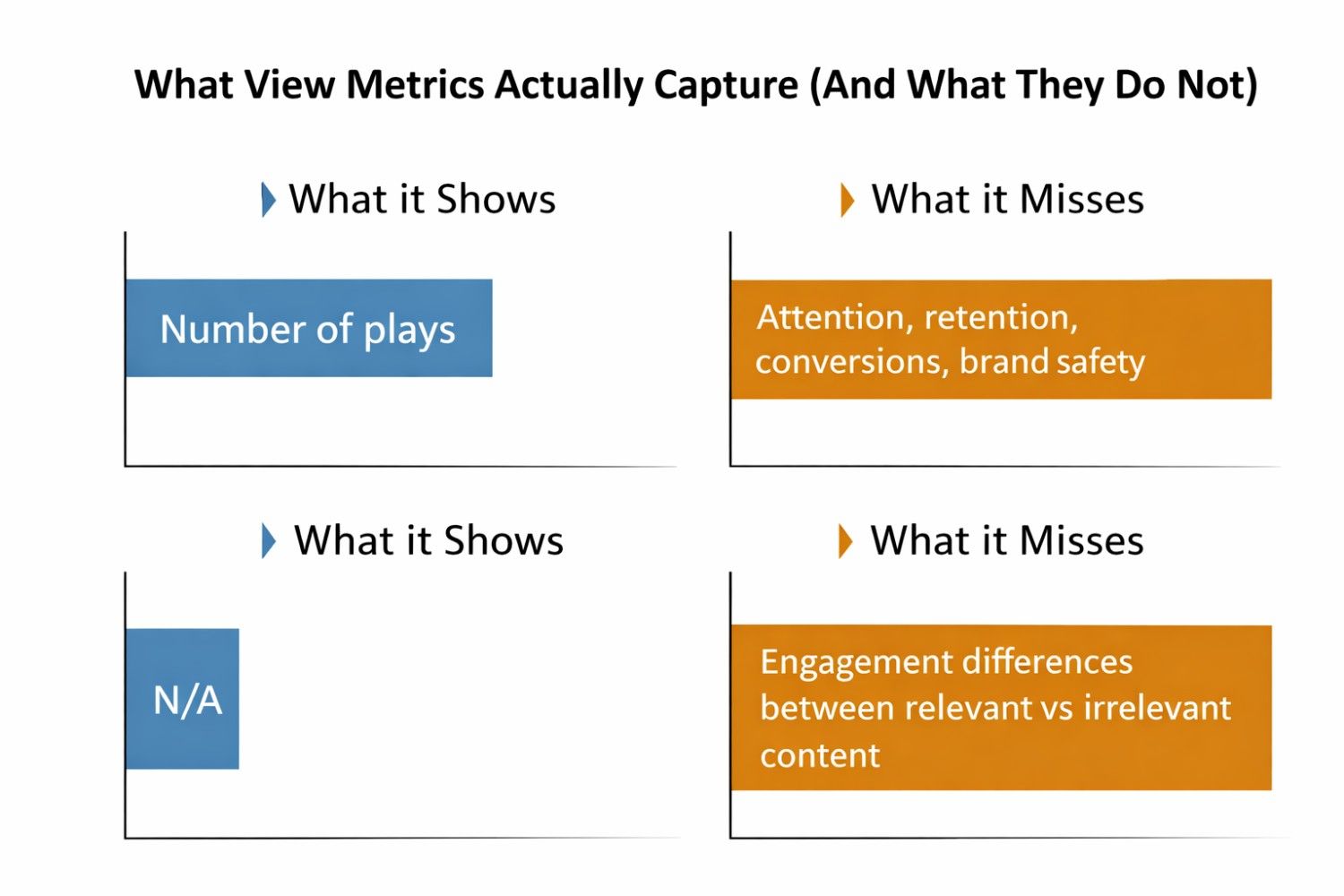
What View Metrics Actually Capture (And What They Do Not)
- Platforms report a “view” when a video plays past a minimum threshold, typically 3-5 seconds
- This does not guarantee that the viewer was paying attention.
- It does not ensure the ad was watched to completion.
- It says nothing about whether the viewer remembered your brand or acted on the message.
Placement is equally important. Ads appearing on irrelevant or unsafe content may still be counted as views, but the impact on your brand and conversions may be negligible.
Metric | What it Shows | What it Misses |
Views / VTR | Number of plays | Attention, retention, conversions, brand safety |
Placement quality | N/A | Engagement differences between relevant vs irrelevant content |
Why Views Alone Aren’t a Good Measure of Success
A campaign can generate thousands of views while:
- Engagement remains low
- Retention is poor
- Conversions are negligible
This creates the vanity metric trap, where marketers believe their campaign is performing, while the real impact on business outcomes is minimal.
What Real Success Looks Like: Metrics That Matter
A robust KPI framework aligns with campaign goals. Tracking multiple metrics ensures you capture both reach and meaningful impact.
Campaign Goals and Real KPIs
Campaign Goal | KPIs to Track | What They Reveal |
Brand awareness | Impressions, Reach, Unique views, Brand lift survey, % wasted impressions (kids, foreign, etc.) | How many people saw your ad, and if they remember it |
Consideration / Interest | View-through rate, Completion rate, Average watch time, Audience retention, Play rate, % of impressions on relevant content | Engagement and meaningful viewing behavior |
Conversion / Action | Click-through rate, Leads/sign-ups, Cost per acquisition, Return on Ad Spend, View-through conversions | Whether ads drove valuable actions or sales |
Retention / LTV | Repeat visits, Return video engagement, Customer lifetime value, Repeat purchase rate | How well your brand nurtures and keeps customers |
Focusing on these KPIs allows you to assess what drives business results, rather than relying on superficial view counts.
How to Build a Smart KPI Framework for YouTube
Step 1: Define Your Primary Goal
Before launching a campaign, identify what you want to achieve:
- Awareness
- Interest or consideration
- Conversion or action
- Retention or long-term value
Your goal determines which KPIs to track and which metrics matter most.
Step 2: Choose Metrics Aligned With That Goal
Pick 2 to 4 KPIs from the above table. Do not track everything, as it may distract you and make the insights unrecognized. A few pertinent KPIs are the source of operational intelligence.
Step 3: Use Proper Tools and Tracking
- YouTube Analytics: Completion rate, watch time, CTR
- Google Analytics: Conversion tracking, behavior flow
- UTM/tracking tags: Attribute actions back to your campaigns
- Third-party reporting: Place verification of audience relevance and safety
Step 4: Monitor, Optimize, Repeat
It is crucial to conduct regular reviews and tests:
- A/B test of creative, targeting, and calls-to-action
- Changing placement strategies according to KPI performance
- Optimizing video length and format based on engagement data
Why Contextual and Brand-Safe Placements Matters
Even with the right KPIs, poor placement can ruin performance. Ads on kids channels or unsafe content can hurt engagement, brand perception, and conversions, all while inflating view counts.
Filament ensures:
- Ads appear on contextually relevant channels
- Brand safety is protected
- KPI metrics reflect true performance
Placement Factor | Benefit |
Safe & verified channels | Protects brand reputation |
Relevant content | Higher engagement and conversions |
Contextual targeting | Real KPI data, not inflated views |
When KPI measurement and placement are combined, you invest in impact, not just impressions.
Common Mistakes Video Marketers Make and How to Avoid Them
High YouTube view counts are often celebrated as success; however, those figures might not tell the whole truth. The actual success lies in the proper tracking of meaningful KPIs and ensuring the ads appear in a safe and relevant manner, rather than merely getting views.
1. Tracking Views Only
Why it’s risky: Views alone do not indicate interest or action. An ad may be visible yet ignored.
Better approach: Monitor a variety of KPIs like watch time, completion rates, click-through rates (CTR), conversions, and repeat engagements.
2. Overloading Dashboards
- Why it’s risky: Excessive metrics can overwhelm decision-making and obscure key insights.
- Better approach: Select 3–5 KPIs that have a direct link to your campaign goals. Keep the dashboards neat and easy to act upon.
3. Ignoring Attribution
- Why it’s risky: You run the risk of attributing the sales made to the ads that never really helped the situation, consequently creating a false impression of success.
- Better approach: Employ suitable attribution models or control group tests to ascertain the incremental impact.
4. Assuming All Placements Perform the Same
- Why it’s risky: Ads on unsafe or irrelevant channels can damage brand image and distort metrics, even if other placements perform well.
- Better approach: Go through placements meticulously. Give precedence to contextually relevant and brand-safe channels for advertising.
5. Treating All Formats the Same
- Why it’s risky: Different ads, irrespective of time length or position, have different ways of acting. Wrongly choosing the format for the purpose can make it ineffective.
- Better approach: Select the format according to the campaign objective. For instance, use short videos for awareness, long videos for storytelling, and interactive or shoppable videos for conversions.
Why Video Marketing Works, When Done Right
Video is highly effective when paired with proper KPI frameworks and safe placements.
- Statista: 83% of U.S. internet users watched digital video in 2025
- Pew Research: 84% of U.S. adults use YouTube
When campaigns are goal-driven, tracked properly, and placed on safe channels:
- Brand recall improves
- Consideration and conversions rise
- Long-term engagement increases
Practical Tips for YouTube Campaigns
You can boost YouTube campaign performance by focusing on the true drivers of results rather than surface-level metrics.
1. Prioritize High-Impact KPIs Over Vanity Metrics
Count on metrics that reflect real campaign performance, such as watch time, click-through rate, conversions, and retention, rather than just view counts.
2. Leverage Short-Form Videos for Maximum Attention
Videos of 30-90 seconds are ideal for capturing and holding viewers’ attention, particularly on mobile and social platforms.
3. Incorporate Interactive or Shoppable Elements
The viewer can choose their way of interaction through quizzes, polls, or clickable product links that are embedded in videos, and thus, engagement is achieved, and measurable actions are driven.
4. Monitor Audience Retention to Improve Content
Where the viewers have left is to be analyzed so that the next campaigns’ messaging, pacing, and creative can be refined.
5. Align Internal Teams Around KPI Goals
Ensure all teams, be it paid media, creative, and analytics, understand and track the same KPIs to maintain clarity and accountability.
Recommended KPIs by Video Type
Video Type | Best KPI | Why It Matters |
Short-form ads | Completion rate, CTR | Engagement and immediate action |
Long-form content | Watch time, audience retention | Shows deeper engagement |
Interactive/shoppable | Conversion rate | Directly linked to revenue |
Branded content | Brand lift survey | Measures perception and recall |
Frequently Asked Questions:
1. Why is a “view” not enough to measure success?
A view only indicates that the video played. It does not reveal whether the viewer watched attentively, remembered your brand, or acted.
2. What metrics should I use instead of views?
Depending on your goal: track watch time, completion rate, audience retention, CTR, conversions, cost per acquisition, repeat visits, and retention.
3. How many KPIs should I track per campaign?
Three to five KPIs are ideal. Tracking too many metrics can dilute focus.
4. Why does ad placement matter so much?
Placement affects context, audience relevance, and engagement. Ads on unsafe or irrelevant content may generate views but fail to deliver impact.
5. How does a partner like Filament help?
Filament ensures ads run on safe, high-quality, relevant channels. This improves targeting, reduces wasted impressions, maintains brand safety, and ensures KPIs reflect real value.

I’m a results-driven marketing leader with 10+ years of experience building integrated media strategies that drive measurable ROI. As COO and co-founder of Filament, I shape the product roadmap, sales, and campaign performance. My background spans brand and performance media for top brands like Slack, Bumble, and Jenny Craig. A frequent speaker on measurement, I bring deep expertise in ad tech, data strategy, and media buying—always with a sharp focus on business impact. Previously I founded an attribution company, where I led campaign planning, attribution modeling, and executive-level reporting across TV, digital, and CRM channels.