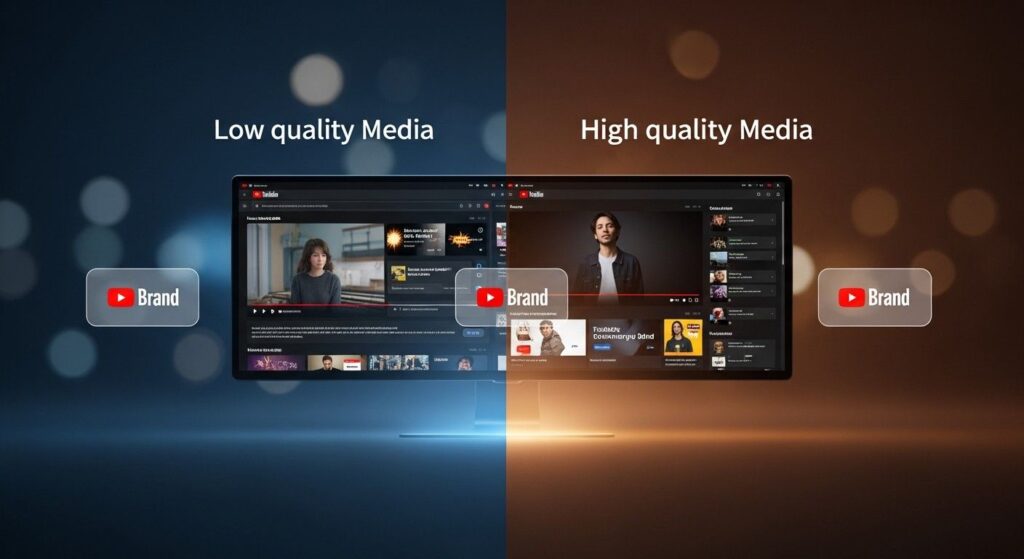
Buying ads is no longer the hard part. You can launch a campaign in minutes, scale spend in hours, and reach massive audiences almost instantly.
What you can’t do is take back where those ads showed up.
The digital ad ecosystem has grown faster than anyone’s ability to police quality. Inventory has exploded. Content has fragmented. Algorithms optimize for delivery, not judgment. As a result, brands often discover bad placements only after the damage is done.
Today, media quality determines whether advertising builds trust or quietly erodes it. It affects efficiency, perception, and performance long after a campaign ends. Media quality is no longer a media buying detail. It is a brand decision.
What is “Media Quality” in Advertising
Media quality in advertising refers to the environment, context, and relevance in which an ad appears. It is not a vanity metric and it is not interchangeable with scale.
High media quality answers three fundamental questions:
- Where did the ad appear?
- What content surrounded it?
- Who was actually watching?
An impression only has value when it appears in a setting that supports the brand’s message and reaches an audience that is relevant and attentive.
Media Quality vs Media Quantity
Media Quantity | Media Quality |
Optimizes for exposure | Optimizes for impact |
Prioritizes reach and volume | Prioritizes relevance and context |
Measures success by impressions and CPM | Measures success by attention and engagement |
Treats all impressions as equal | Recognizes that placement changes value |
Relies on platform defaults | Requires intentional placement decisions |
A useful analogy comes from traditional television.
A prime-time placement during a major live event carries far more value than the same ad aired at 1 a.m. during an infomercial. The creative is identical. The outcome is not.
Digital advertising works the same way. Context determines effectiveness.
Why Media Quality Has Become a Competitive Advantage
Media quality did not suddenly become important. What changed is the risk of ignoring it.
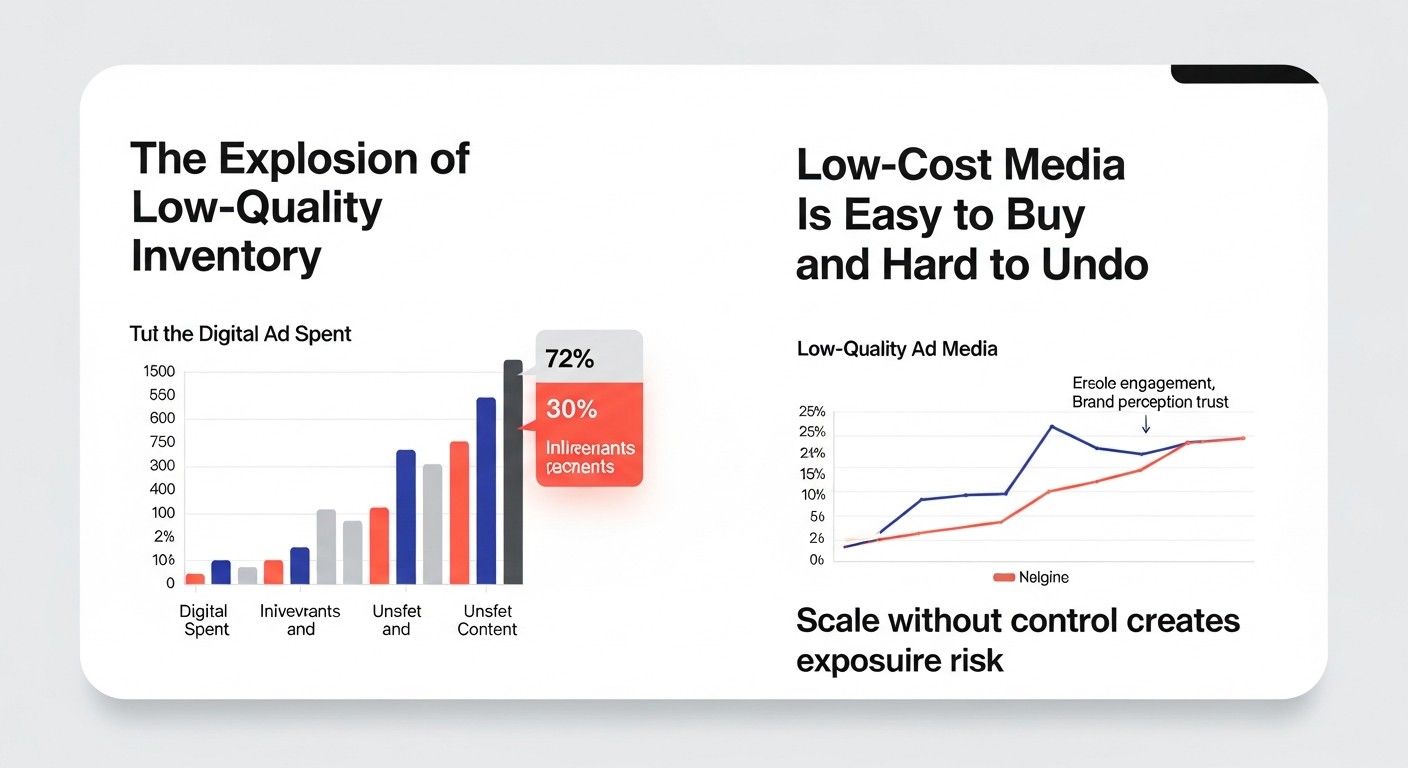
The Explosion of Low-Quality Inventory
Programmatic advertising made scale easy. Algorithms now distribute ads across massive, fragmented ecosystems with minimal friction.
According to Statista, digital advertising already accounts for more than 70% of total global ad spend and continues to grow year over year. More spend means more inventory. More inventory increases the likelihood of:
- Irrelevant placements
- Low-attention environments
- Unsafe or off-brand content
Scale without control creates exposure risk.
Low-Cost Media Is Easy to Buy and Hard to Undo
Media quality is downgradeable. Cost pressure often pushes brands toward broader, cheaper placements. Over time, these lower standards become normalized.
The damage is rarely immediate. It compounds quietly through:
- Reduced engagement
- Weakened brand perception
- Long-term trust erosion
Once audiences associate a brand with low-quality environments, reversing that perception requires significant effort and time.
How Poor Media Quality Directly Hurts Brands
Poor media quality does not just reduce performance. It changes how a brand is perceived.
Brand Trust Is Contextual
Audiences judge brands by the environments they appear in. Ads do not exist in isolation. They inherit the credibility of surrounding content.
Research from the Interactive Advertising Bureau shows that a majority of consumers report lower trust in brands whose ads appear next to inappropriate or low-quality content. This applies even when the creative itself is strong. Placement overrides message.
Wasted Spend Is Not Always Visible in Dashboards
Poor media quality often hides behind acceptable metrics:
- Impressions look healthy
- CTR appears reasonable
- Spend stays within budget
But relevance and intent are missing. Ads reach people who were never likely to engage, convert, or remember the brand.
This is silent waste: budget spent without meaningful impact.
Media Quality vs Media Cost: The False Trade-Off
Many advertisers treat cost efficiency and media quality as opposing forces. They are not. The confusion usually comes from relying on CPM as a signal when it is only a pricing metric.
Low-Cost / Low-CPM Media | High-Quality Media |
Optimized for price | Optimized for impact |
Measures efficiency by CPM | Measures efficiency by attention and outcomes |
Prioritizes cheap impressions | Prioritizes relevant environments |
Often appears in low-engagement placements | Appears where audiences are attentive |
Higher risk of being ignored or skipped | Higher likelihood of recall and action |
Can quietly dilute brand perception | Reinforces brand credibility |
Why Low CPM Does Not Equal Efficiency
CPM only tells you what you paid for an impression. It does not measure attention, relevance, or brand impact. Cheap impressions often signal environments where ads are ignored, skipped, or forgotten. That said, not all cheap inventory is bad, and not all expensive inventory is good.
Why Quality Placements Are More Effective
High-quality placements typically deliver fewer impressions, but those impressions reach the right audience in the right context. Academic research published shows that ads placed in high-quality, contextually relevant environments achieve significantly higher recall and engagement than ads in low-quality settings.
Efficiency comes from impact, not volume.
Why Media Quality Matters More on YouTube Than Anywhere Else
YouTube is one of the most powerful advertising platforms available. It is also one of the most complex, especially when it comes to YouTube brand safety.
YouTube’s Scale Is Also Its Risk
YouTube’s content ecosystem includes:
- User-generated videos
- Kids content
- AI-generated spam
- Foreign-language and off-brand channels
Without deliberate controls, ads can appear in environments that do not align with brand goals or values.
Default YouTube Buying Prioritizes Scale, Not Suitability
Google Ads optimizes for delivery and performance signals. It does not inherently optimize for:
- Brand safety
- Contextual alignment
- Quality content
That responsibility sits with advertisers.
Human Verification vs AI-Only Placement Decisions
Automation enables scale. It does not guarantee quality.
What Algorithms Miss
AI systems struggle with:
- Context nuance
- Tone and intent
- Cultural relevance
- Brand suitability versus basic brand safety
Content can be technically safe and still completely wrong for a brand.
Why Human Review Changes Outcomes
Human reviewers identify issues machines flag late or never. They evaluate content the way audiences do, not the way systems categorize it. Human verification improves contextual accuracy and ensures placements are aligned with brand expectations. Media quality becomes a matter of precision, not restriction.
How Media Quality Improves Performance Across the Funnel
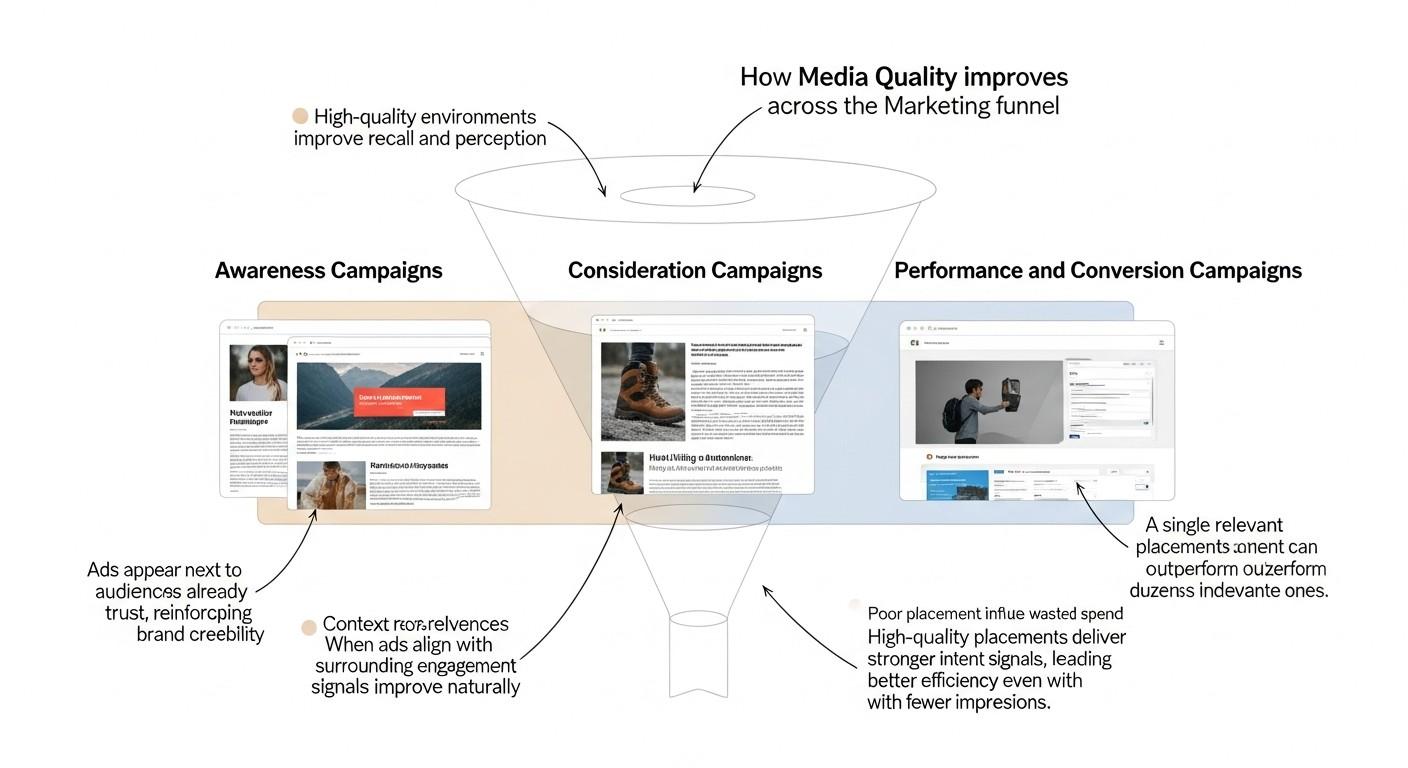
Media quality influences results at every stage of the buyer journey.
Awareness Campaigns
High-quality environments improve recall and perception. Ads appear next to content audiences already trust, reinforcing brand credibility.
Consideration Campaigns
Context reinforces relevance. When ads align with surrounding content, engagement signals improve naturally.
Performance and Conversion Campaigns
Poor placements inflate wasted spend. High-quality placements deliver stronger intent signals, leading to better efficiency even with fewer impressions.
A single relevant placement can outperform dozens of irrelevant ones.
What High-Quality Media Looks Like in Practice
Media quality is operational, not theoretical.
Clear Placement Visibility
Advertisers know where ads actually ran. Transparency exists at the channel level, not just at the platform level. This means going beyond the endless list of channels that Google offers; you need a technology that can easily show where spend is going.
Contextual Alignment
Ads appear next to content that supports the message and reinforces brand positioning.
Continuous Exclusion of Low-Quality Inventory
Quality control is ongoing. It is not a one-time blocklist. Low-quality placements are identified and excluded continuously.
How Filament Approaches Media Quality on YouTube
Filament focuses on one thing: ensuring YouTube ads appear in the right environments.
Filament provides:
- Human-verified YouTube channel intelligence
- Automated curation combined with expert review
- Daily exclusion of unsafe or irrelevant placements
- Channel-level transparency and reporting
- Support for awareness, consideration, and performance campaigns
This approach turns YouTube from a black box into a controllable, high-quality media channel.
Media Quality Is How Brands Protect and Grow
Media quality protects trust, improves efficiency, and creates real competitive advantage. In a fragmented digital ecosystem, brands that control placement outperform those that chase scale. Smart brands do not ask how many impressions they bought.
They ask where their ads actually appeared.
If you want to understand your current placement quality, reduce wasted spend, and protect your brand on YouTube, the next step is clear. Audit your placements. Request a demo or explore Filament’s self-service platform to see media quality in action.
Frequently Asked Questions:
1. What is media quality in advertising?
Media quality refers to the relevance, safety, and context of where ads appear, not just how many impressions they generate.
2. Why does media quality matter more than CPM?
CPM measures cost, not value. Low CPM placements often deliver low attention and weak engagement, increasing wasted spend.
3. How does media quality affect brand safety?
Ads inherit the reputation of surrounding content. Poor placements can damage trust even when the creative is strong.
4. Is media quality more important on YouTube?
Yes. YouTube’s scale and user-generated content make placement control essential for protecting brand reputation and performance.
5. Can automation alone ensure media quality?
Automation enables scale, but human verification is necessary to assess context, tone, and brand suitability accurately.

I’m a results-driven marketing leader with 10+ years of experience building integrated media strategies that drive measurable ROI. As COO and co-founder of Filament, I shape the product roadmap, sales, and campaign performance. My background spans brand and performance media for top brands like Slack, Bumble, and Jenny Craig. A frequent speaker on measurement, I bring deep expertise in ad tech, data strategy, and media buying—always with a sharp focus on business impact. Previously I founded an attribution company, where I led campaign planning, attribution modeling, and executive-level reporting across TV, digital, and CRM channels.