Most marketers think of Connected TV (CTV) as a top-of-funnel tool. Big screens. Big reach. Big branding. But here’s the secret: YouTube CTV isn’t just for awareness. It can drive site traffic, leads, and even purchases.
With 88% of U.S. households owning at least one CTV device, think Roku, Amazon Fire TV, or Apple TV, your audience is already watching. And they’re paying attention. YouTube CTV ads can reach entire households in a lean-back, high-attention environment. There’s high potential for conversions.
Filament makes sure every ad lands on safe, relevant YouTube channels with precision targeting that maximizes performance.
Why YouTube CTV Works for Conversions
YouTube Connected TV is no longer just for awareness. It combines TV-like attention with digital measurability, giving advertisers the ability to influence viewers and track actions across devices.
- High CTV viewership: Over 60% of YouTube watch time happens on CTV devices. Ads reach viewers in a focused, lean-back environment.
- Longer, attentive sessions: On big screens, skipping is lower and messages are easier to retain.
- Household co-viewing: Ads are often seen by multiple people in the home, increasing influence.
- Strong completion rates: Attentive viewers improve Cost per View (CPV) and engagement metrics.
- Cross-device impact: Exposure on TV can lead to actions on mobile, desktop, or tablet, making conversions measurable.
- Better value for performance campaigns: While CPMs can be higher, strong engagement and downstream actions make CTV cost-effective for conversions.
Running ads on relevant and brand-safe channels ensures YouTube CTV supports lower-funnel goals while keeping the reach and impact of traditional television.
How CTV Moves Viewers Down the Funnel
CTV ads can do more than build awareness. They can push audiences to act. Here’s how:
- Interactive CTAs: Send-to-phone links can move viewers directly from TV to the landing page.
- Longer ad exposure: More time to explain your product. More time to persuade.
- Household targeting: Everyone in the home sees your message. That includes decision-makers.
Conversion Table: What You Can Achieve
Conversion Type | Why CTV Helps | Potential Lift |
Product page visits | QR codes, CTAs link viewers instantly | +20–40% traffic |
Lead form submissions | Longer viewing + clear CTAs | +15–25% leads |
App downloads | QR codes, send-to-phone | +10–20% completion |
In-store / online purchases | Retargeting across devices after TV exposure | +8–15% incremental sales |
Target the Right Audience, Every Time
Placement is everything. Even the best creative fails if it appears on irrelevant or unsafe channels. That’s where Filament shines.
Using a mix of automation and human verification, Filament ensures your ad runs on channels that make sense for your brand with brand-safe placements.
Audience Targeting Made Simple
Targeting Strategy | How It Helps |
Household targeting | Reach all decision-makers at home |
Geo-targeting | Run local, regional, or national campaigns |
Behavioral & interest targeting | Target people already interested in your niche |
Time-of-day scheduling | Catch viewers when they’re most engaged |
Contextual channel selection | Align ads with relevant, safe content |
This combination guides viewers from awareness to action without wasting impressions.
Measuring Conversions: Go Beyond Impressions
Watching a CTV ad is only the first step. Here are some metrics that can help judge the effectiveness of a campaign:
- Video Completion Rate (VCR): Was the whole advertisement viewed by the audience? High completion rates are an indicator of involvement. If the viewers are up to the last second, then they are more likely to take action.
- Cost Per Completed View (CPCV): Find out the cost of one complete view. Reducing CPCV while keeping the engagement level high will directly result in a better ROI for conversion-oriented campaigns.
- Direct Conversions: Employ QR codes, links sent to phones, or clicks to monitor sign-ups, downloads, purchases, or any other action that can be measured.
- Cross-device Attribution: A viewer’s ad viewing on the TV does not necessarily mean they will take action there. Monitor the process whereby the exposure converts into actions through mobile, desktop, and tablet users.
- Wasted Impressions: By default campaigns waste 20-50% of impressions on kids, foreign, unsafe content, and background music. Applying Filament’s Daily Exclusion list can remove up to 98% of wasted impressions, and monitoring the total waste makes every dollar work harder.
How to Integrate CTV Data with Your Marketing Tools
You can make your CTV data useful by linking it to the tools you are already using:
- Join together your campaigns with Google Analytics 4 (GA4) or your CRM to see the downstream impact.
- Obtain upper funnel insights via Brand Lift studies and measure direct lower-funnel actions with Conversion Lift studies.
- Incorporate the results into media mix modeling (MMM) to evaluate the performance of YouTube CTV against other channels and to streamline your budget allocation.
Full-Funnel Strategy: From Awareness to Conversion
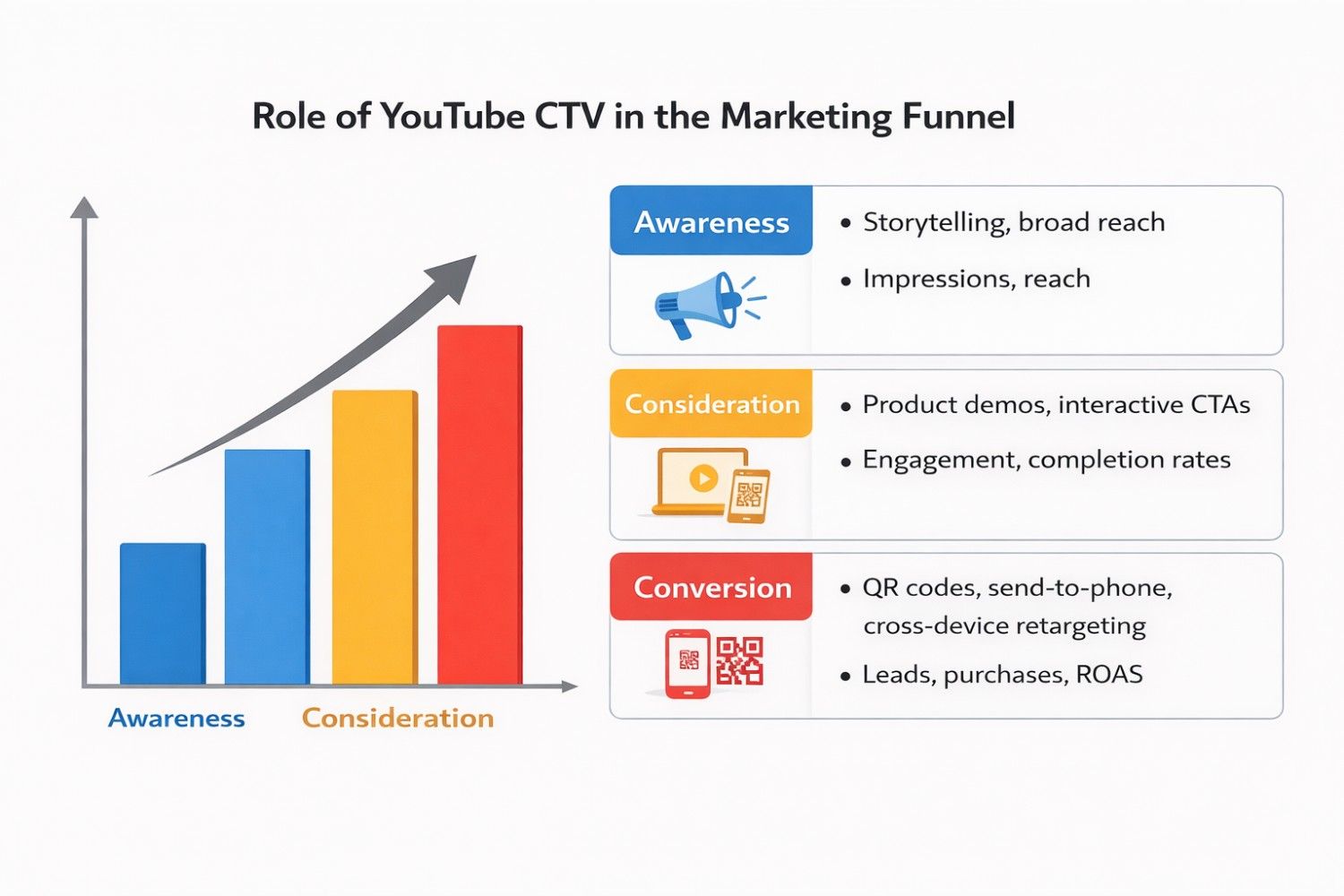
CTV is not a single solution, it is a powerful part of a greater effort. An intelligent full-funnel approach ensures your messaging reaches the audience throughout their journey, including:
- Top-of-Funnel: Develop storytelling with a TV-like quality that attracts the attention of the viewers and increases awareness. Do not forget that the first impression is very important.
- Mid-Funnel: Retarget engaged viewers through display, social, or search ads to keep them interested and moving closer to conversion.
- Bottom-of-Funnel: Deploy YouTube CTV ads with clear CTAs, QR codes, or send-to-phone links to drive the final action.
Funnel Stage | Role of YouTube CTV | KPI to Track |
Awareness | Storytelling, broad reach | Impressions, reach |
Consideration | Product demos, interactive CTAs | Engagement, completion rates |
Conversion | QR codes, send-to-phone, cross-device retargeting | Leads, purchases, ROAS |
Example: A SaaS company ran CTV ads with send-to-phone links, targeting households with decision-makers. Sign-ups rose 25%, and downstream conversions were measurable and consistent.
Tips for Better Conversions
Running a YouTube CTV ad is just one step in the conversion process. Success depends on smart, targeted strategies that guide viewers from awareness to action.
1. Use Send-to-Phone Links
Send-to-phone links create instant pathway for viewers to take action. A send-to-phone link allows the viewer to transition from a TV commercial to the website or landing page in a matter of seconds, thereby turning the viewer from a passive audience into an engaged one.
2. Rotate Placements to Avoid Ad Fatigue
Keep your ads new by moving them across verified, safe channels. Rotation prevents the audience from getting bored with the ad, but at the same time provides good reach.
3. Stick to Brand-Safe Channels
Advertising where your brand does not belong is a waste of money. The verification of Filament guarantees that every placement is safe, related, and effective, thus shielding both the brand’s image and its ROI.
4. Keep Messaging Short and Impactful
Audiences in CTV tend to be watching at a distance and often in groups. Front-load your key message in the first 5–6 seconds, use clear visuals, and focus on one benefit at a time.
5. Monitor Metrics and Adjust Weekly
Every week, keep an eye on the completion rates, conversions, and placements. Change the frequency, creatives, and calls-to-action to continually have the campaigns reach their maximum performance.
6. Test Ad Lengths
Try out the 15–30 second spots. Although shorter ads in many cases are able to get the attention faster, testing will tell you what works best with your audience.
Why Filament Makes the Difference
Buying YouTube CTV ads without Filament means Google is going to waste up to half of your budget. Irrelevant channels, unsafe content, and low-performing placements tank ROI, and are included by default by Google. Even legacy brand safety tools only report on the problem, not actually blocking the wasted impressions.
Filament ensures your ads appear on channels that fit your brand and your audience. Human verification plus automation means you get precision targeting ensuring relevant placements, and a 99% brand-safe guarantee.
When your goal is lower-funnel results, not just awareness, this approach is critical. Every ad counts. Every impression matters.
Turn YouTube CTV into a Conversion Machine
YouTube CTV is not only for awareness. It is capable of leading, signing up, downloading, and selling, provided it receives the right placement, audience targeting, and measurable strategies. Filament revolutionizes the process, making it easy, secure, and efficient.
Do you want to make sure your views turn into sales?
Let Filament improve your YouTube inventory. Make your campaigns secure, appropriate, and tailored for measurable results.
Frequently Asked Questions:
1. What’s the difference between CTV and OTT?
CTV is the device: smart TVs, Roku, Fire TV. OTT is the content delivered online. CTV ads appear on these devices; OTT can be viewed anywhere.
2. Can YouTube CTV reach specific households?
Yes. You can target households by IP, interests, and behavior. Every decision-maker in the home can see the ad.
3. How do I measure conversions from CTV ads?
Use QR codes, send-to-phone links, cross-device retargeting, and GA4/CRM integration.
4. Do I need to produce creative content to run CTV ads?
No. Filament focuses on safe and relevant placements. Creative is optional but can improve results.
5. Is YouTube CTV cost-effective for smaller budgets?
Absolutely. Programmatic buying allows entry at a lower cost than traditional TV, while still delivering measurable engagement.

I’m a results-driven marketing leader with 10+ years of experience building integrated media strategies that drive measurable ROI. As COO and co-founder of Filament, I shape the product roadmap, sales, and campaign performance. My background spans brand and performance media for top brands like Slack, Bumble, and Jenny Craig. A frequent speaker on measurement, I bring deep expertise in ad tech, data strategy, and media buying—always with a sharp focus on business impact. Previously I founded an attribution company, where I led campaign planning, attribution modeling, and executive-level reporting across TV, digital, and CRM channels.