YouTube still holds the largest share of the online video market, and its influence keeps growing every year. New privacy regulations have restricted the targeting options available to some advertisers. The transition to a new era of user targeting based solely on their interest has finally arrived.
What is in store for advertisers now is to come up with a more intelligent marketing plan, which will combine their first-party data with contextual targeting. This method places ads in front of viewers already interested in a topic, without invading privacy or depending on older signals.
YouTube reaches 95% of U.S. teens, with 19% saying they use the platform “almost constantly.” Meanwhile, YouTube ad revenue hit $36.1 billion in 2024, underlining how powerful and profitable the platform remains. That means the opportunity is massive if you place your ads smartly.
Why Third-Party Cookies Are Disappearing
For decades, the digital ad ecosystem was predominantly reliant on third-party cookies, tiny bits of data that were used to follow users across different websites and, eventually, to create vast behavioral profiles.
This practice is on its way out. Google Chrome is advancing its Privacy Sandbox initiative that has the primary aim of limiting cross-site tracking. On the other hand, Safari’s built-in Intelligent Tracking Prevention (ITP) now blocks most third‑party cookies by default, preventing cross-site tracking.
Traditional cookie-based targeting is becoming less accurate and less comprehensive. Without cross-platform tracking, advertisers lose key intent signals, making it harder to optimize campaigns. Audiences become fragmented, and budgets may drift toward impressions with little value rather than toward meaningful conversions.
First-Party Data: The Foundation You Already Own
First-party data is information your brand collects directly from your customers, your website, your app. Unlike third-party data, first-party data is permission-based. It’s accurate. And critically, it’s still usable even as cookies fade.
Examples of First-Party Data:
- CRM records: Data that originates from the sales systems, loyalty programs, and customer databases, e.g., (HubSpot, Salesforce).
- Purchase history: What customers bought, when they bought, and how often.
- Website behavior: Pages they visited, forms they filled out, carts they abandoned.
- Email engagement: Newsletter sign-ups, lead magnet downloads, survey responses.
- App usage: The user’s engagement with your application, either mobile or web, and the actions they performed, such as clicking, visiting that, or spending time on that.
On YouTube, this data becomes powerful. Using Google’s Customer Match, you can upload a list of your customers and target them (or similar people) with YouTube ads without relying on third-party tracking. (Google Support)
First-Party Data Sources & YouTube Activation
Source Type | Example | YouTube Use Case |
CRM | HubSpot or Salesforce | Upload for Customer Match and retargeting |
Purchase History | E‑commerce or POS | Create high-value buyer segments |
Website Analytics | GA4 | Retarget visitors who viewed key pages |
App Usage | Mobile/Web App | Promote upgrades or subscriptions |
Email Opt-ins | Newsletters, Lead Magnets | Build lookalike audiences |
Why First-Party Data Matters:
- Higher precision: You reach people who already know your brand.
- Better performance: Customers from your database tend to convert at higher rates.
- Privacy compliance: Since this data is collected with their consent, you’re playing by the rules.
Contextual Targeting: Ads That Fit the Content
First-party data provides you with information about your customers, while the use of contextual targeting aids in selecting the site where your ads would be most effective. The criticism mostly revolves around users’ actions over the internet; rather, the focus is on the metered content consumption of the users at that moment.
What Is Contextual Targeting?
It is the process of matching the advertisements with the contents of the website or video, not with the users. When contextually aligned, your marketing message has the certainty of always being in proper and non-offensive contexts.
How Tech + Humans Delivers Accuracy:
- Semantics: The tech uses page or video transcripts to grasp the meaning.
- Thematic grouping: The connected ideas are placed together for more relevance.
- Scoring of sentiment and safety: Content gets qualified for its brand appropriateness.
- Human Input: Reviews the nuance, cultural context, and brand safety.
Instance: A tax filing software promotion could be on YouTube only for content like “Tax Tips for Small Business Owners” or “How to File Taxes for Freelancers.” This content matches the user intent, and, besides this, no need for cookie tracking.
Contextual vs Behavioral Targeting
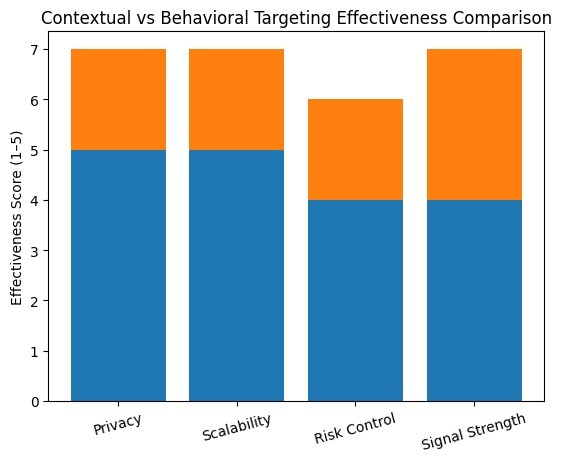
Feature | Contextual Targeting | Behavioral Targeting |
What is analyzed | Content (video/audio/text) | User identity + browsing behavior |
Privacy | Privacy-first, no cross-site tracking | Often surveillance-based |
Scalability | High, regardless of cookies | Declining as cookies disappear |
Risk | Possible brand adjacency issues | Misfires & poor placements |
Signal strength | Strong when content is relevant | Based on past, not current, behavior |
Merging First-Party Data with Context: A Powerful Combo
These two strategies: first-party data and contextual targeting don’t just work side by side. They amplify each other.
Here’s a step-by-step YouTube campaign model that works:
- Upload Your Customer List
Use CRM data (email addresses or customer IDs) to create a Customer Match audience.
- Create Lookalike Audiences
Let Google expand your reach by finding users similar to your known customers.
- Apply Contextual Targeting with Filament
Use thematic targeting to narrow content to topics that match your brand or product.
- Exclude Risky Content with Daily Exclusion Lists
Use brand-safety filters to avoid content categories that don’t align with your values.
- Optimize and Scale
Start with a smaller test budget. Monitor view rate, conversions, and engagement. Scale where you see results.
Real-World Example:
A SaaS HR brand uploads its CRM list to YouTube using Customer Match. The brand targets HR leaders and professionals. Then it uses contextual filters so ads run only on videos about onboarding, payroll, or workplace culture. It avoids gaming, politics, or entertainment content. This ensures relevant reach while keeping brand safety tight.
Multi-Channel Synergy: Extend Beyond YouTube
YouTube’s first-party data paired with contextual targeting makes the most excellent foundation, but they become even more effective when used as part of a wider cross-channel plan.
The integration of the various strategies mentioned will result in something like this:
- Email Retargeting: Allows you to send customers who interacted with your ads on YouTube personalized follow-up emails.
- Social Lookalikes: Sees you making excellent use of your CRM data in the creation of lookalike audiences on the social networks of Facebook, Instagram, or LinkedIn.
- Web Personalization: Enables you to show different site banners or content according to the various CRM segments.
A case of a cookware brand running YouTube recipe videos followed by recipe emails to viewers, personalized dish ideas on the brand’s website, and targeting similar audiences on Instagram, is a very practical situation. In a way, connecting first-party data with different channels, a brand can engage 10 times more and keep the same marketing budget due to the privacy-safe advertising.
Filament’s Role: Safe, Precise, Scalable YouTube Placements
Filament offers a unique value proposition for brands scaling YouTube campaigns in a cookieless world:
- 99% Brand-Safe Guarantee: We use both automation and human review to verify that channels and content are safe and relevant.
- Topic Mapping: We match YouTube channels to carefully selected themes, not broad categories.
- No Creative Management: Filament does not make your videos, we help you place them where they matter most.
- Performance Focus: Our strategy drives higher view-throughs, better engagement, and removes wasted impressions.
Case Study: A tech company ran a YouTube campaign using Filament’s contextual placements and first-party data. They saw a 35% higher view-completion rate than they did with typical broad targeting because each ad impression was aligned to content aligned with the product and audience.
Measuring Success Without Cookies
Without cookies, performance evaluation shifts toward meaningful outcomes.
Focus on Impactful KPIs:
- View Completion Rate: How many people watched your ad to the end?
- Watch Time: Average time people spent watching.
- Click-Through Rate (CTR): How many clicks does your call to action get?
- Conversions: Signups, demo requests, and purchases tied to your first-party audience.
- High-Value GA4 Sessions: Events and user behavior tracked in Google Analytics 4.
- Revenue Lift: Sales from your Customer Match and Lookalike segments.
Use server-side tracking and GA4 to collect conversions in a privacy-compliant way. GA4’s event-based model helps you tie video engagement to downstream business actions.
Optimizing Over Time:
- Review performance weekly and adjust where needed.
- Use frequency caps so you don’t fatigue your audience.
- A/B test creative formats, messaging, and timing.
- Refine your contextual filters based on performance data.
Win on YouTube with intent-driven placements.
We’ve entered a new era of digital advertising. The disappearance of third-party cookies does not imply the loss of high-intent audience access. Using the first-party data in conjunction with contextual targeting on YouTube, the brands are in a position to show the relevant ads through the privacy-safe channel and, at the same time, increase their performance.
Filament’s YouTube Inventory Curation supports and favors the marketers in this new situation. The combination of human evaluation, brand safety, and intelligence in the contextual placements at the channel level ensures the visibility of your ads on the content that is congruent with your audiences, values, and objectives. No unsuitable videos. No irrelevant channels. Only the correct viewers at the proper time.
The change in direction is a golden opportunity.
Speak with Filament today and access the brand-safe, high-intent YouTube campaigns that are designed for a future without cookies.
Frequently Asked Questions:
1. What is first-party data?
It is the data you collect directly from customers, like emails, purchase behavior, and web actions.
2. Is contextual targeting just guessing what people watch?
No. Modern contextual targeting uses AI for a deep understanding of video content, meaning, and sentiment.
3. Do YouTube campaigns still need cookies?
Not for targeting. Tools like Customer Match and contextual targeting allow precise reach without third-party cookies.
4. How does Filament ensure brand safety?
We use a two-step process: automated filters + human review to vet channels and videos, giving a 99% brand-safe guarantee.
5. What metrics should I focus on in a cookieless campaign?
Track view completion, watch time, signups, demo requests, high-value sessions in GA4, and revenue from matched audiences.

I’m a results-driven marketing leader with 10+ years of experience building integrated media strategies that drive measurable ROI. As COO and co-founder of Filament, I shape the product roadmap, sales, and campaign performance. My background spans brand and performance media for top brands like Slack, Bumble, and Jenny Craig. A frequent speaker on measurement, I bring deep expertise in ad tech, data strategy, and media buying—always with a sharp focus on business impact. Previously I founded an attribution company, where I led campaign planning, attribution modeling, and executive-level reporting across TV, digital, and CRM channels.