YouTube is the biggest video network and can directly impact a business’s bottom line. However, if you base your evaluations solely on last-click reporting, you will most likely overlook the actual contribution of the platform. Incrementality testing allows you to determine and quantify the amount of incremental lift generated by YouTube campaigns over and above standard media buys. With accurate testing, you can make better decisions and invest with greater confidence.
Why Measuring Incremental Lift on YouTube Is Critical
What is Contextual Advertising?
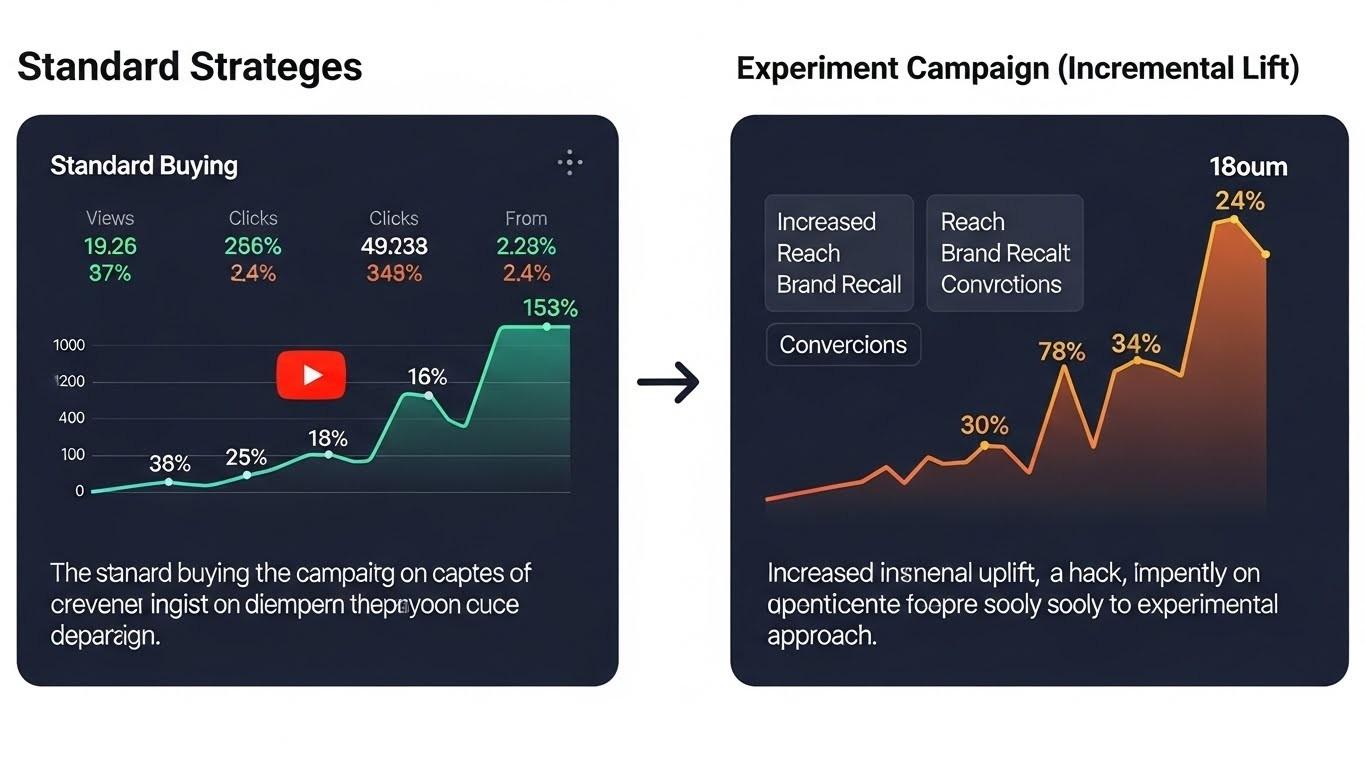
YouTube’s reach and influence are growing rapidly. According to the IAB, U.S. digital video ad spend is set to reach $72.4 billion in 2025, having grown 14% year-over-year from 2024.
Moreover, digital video is expected to comprise nearly 60% of all TV/video ad spending in 2025.
These numbers signal that video is not just about brand play; it’s a major performance channel, too. But standard attribution often fails to give YouTube its due. Because many users watch YouTube, then convert later via search, direct visit, or other channels, last-click metrics might not reflect YouTube’s full impact.
Incrementality testing solves a common marketing problem by showing what actually drives results. By running controlled experiments, you can prove causality. Did the YouTube campaign truly create conversions, or did it just take credit for ones that would have happened anyway? This approach gives marketers clear insight into the real impact of their campaigns.
What is Audience Targeting?
Audience targeting gathers and analyzes user data and activity, like searches and clicks. It then delivers ads as per these activities with the complete intention of making relevant ads show up to the user.
Audience targeting also comes with its set of challenges. The pockets of data a marketer can tap into are being curbed by regulations and increasing concerns relating to data privacy. Moreover, audience advertising is deemed obnoxious by an increasing number of users, who find it an irritating form of advertising.
How to Design and Run a YouTube Incrementality Experiment
Step 1: Define Your Hypothesis & KPIs
Start with a clear hypothesis. For instance:
- “Running YouTube ads in Region A will produce 20% more new sales than in Region B (no YouTube).”
- “YouTube exposure over 4 weeks increases branded search volume by X%.”
Pick KPIs that reflect incremental impact, such as:
- Incremental conversions or revenue
- Incremental Return on Ad Spend (iROAS)
- Incremental Cost per Acquisition (iCPA)
- Lift percentage (growth vs control)
Step 2: Choose the Test Method
Here are common testing methods and when to use them:
Testing Method | Description | Best for |
Geo Holdout | Split by geographic regions: some get YouTube ads, others don’t | Large-scale markets, region-level validation |
Audience Holdout | Exclude a portion of your defined audience from seeing YouTube ads | When you have strong first-party data or defined user segments |
Time-Series On/Off | Turn campaigns on/off in certain weeks or days, then compare performance | Quick tests, or when geographic splits aren’t feasible |
Each of these gives you a control vs treatment group you can analyze for causal lift.
Step 3: Set Up the Experiment
- Use Google Ads (or another platform) to run a “Conversion Lift” test or similar study.
- Define your treatment group (receiving YouTube ads) and your control group (no YouTube).
- Determine your traffic split or budget allocation, make sure it’s balanced.
- Run the test for a meaningful duration, typically 3–4 weeks, or longer if your conversions have a longer delay.
- Avoid changing other campaign settings mid-test to preserve validity.
Step 4: Ensure Test Integrity
- Maintain consistent spend across groups to avoid bias.
- Use historical data to verify that your treatment and control regions/audiences were comparable before the test.
- Monitor potential “leakage”, make sure control users don’t inadvertently get exposed.
- Track external factors (other campaigns, seasonality) that might influence conversion.
Analyzing Experiment Results
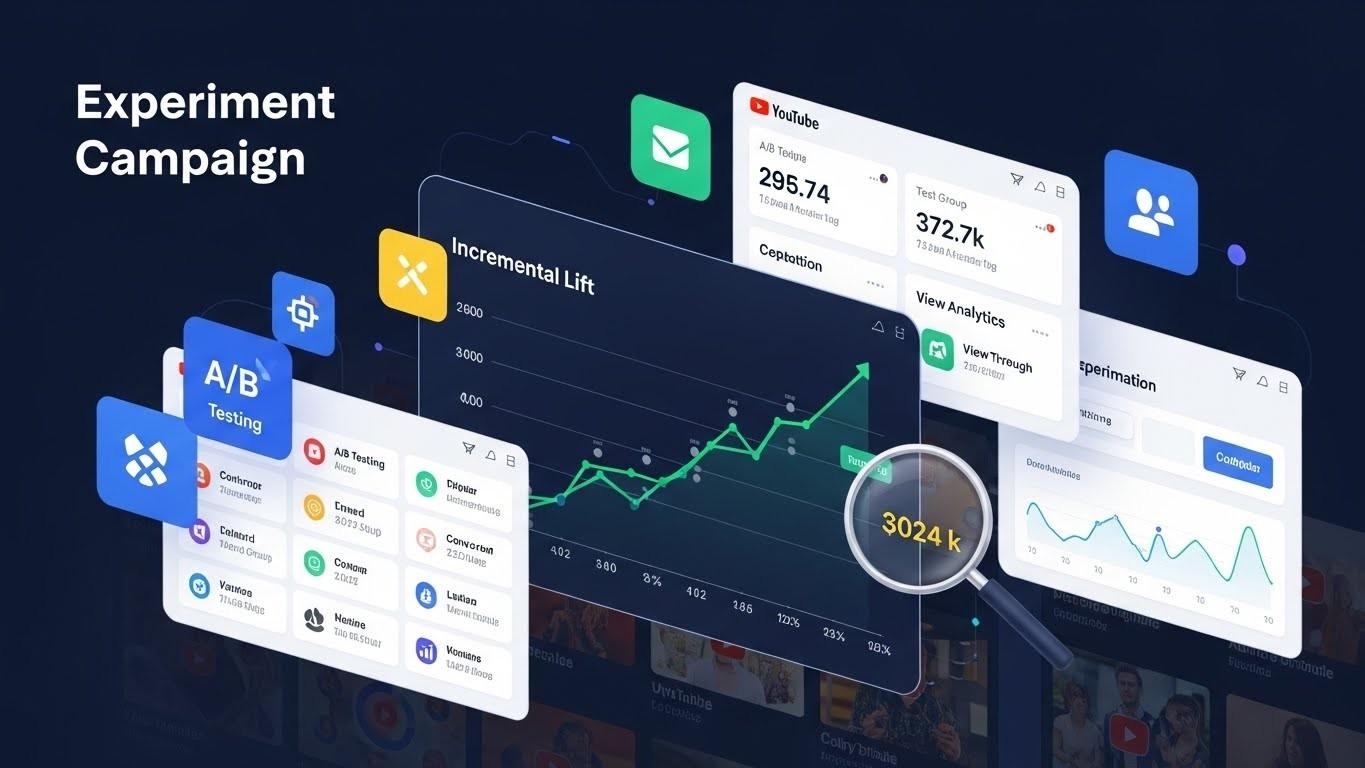
Calculate Incremental Metrics
- Incremental Lift (%) = (KPI_treatment – KPI_control) ÷ KPI_control
- iROAS = Incremental Revenue ÷ YouTube Spend
These tell you how much more business your campaign created over what would have happened without it.
Test for Statistical Confidence
Use statistical tests (e.g., p-values or Bayesian methods) to make sure your observed lift isn’t just noise. Also run sanity checks:
- Did treatment and control have similar trends before the test?
- Was there any unplanned contamination or spend mismatch?
Interpret the Results
- Positive & significant lift → YouTube is causally driving incremental value.
Weak or no lift → Might suggest: targeting needs refining, creative is weak, or YouTube is largely supporting other channels rather than directly converting.
Action Plan: What to Do After the Test
Reallocate Your Budget
- Scale up YouTube spend in regions or audiences that show high iROAS.
- Cut or pause spending where lift was minimal, or re-test with refined targeting or creative.
- Use a phased scale approach, so you keep validating while growing.
Optimize Creative & Placement
- Leverage insights from the test to refine where you place ads: which channels, which content formats, which video lengths.
- Test different formats (6-sec bumpers, 15-sec skippables, 30-sec narrative) based on what drove lift.
- With Filament, you can lean on our expertise in safe, relevant channel curation, ensuring your ads run in contexts where they’re most likely to drive lift.
Integrate Into Cross‑Channel Strategy
- Use your lift data in your Marketing Mix Model (MMM) to feed more accurate predictions and budget forecasts.
- Regularly run lift tests (quarterly or biannually) to make sure your media mix is always optimized.
- Communicate the results internally, show stakeholders how YouTube is truly contributing to overall business goals, not just getting last-click credit.
Why Filament Is the Strategic Partner for YouTube Incrementality
Running the right test is only half the battle; placements matter just as much. We offer:
- Expert placement curation: With automation plus human verification, we ensure your ads run on the safest, most relevant YouTube channels. That precision minimizes waste and avoids low-quality inventory.
- Reduced noise, clearer lift: Because placements are curated for brand safety and relevance, your experimental data is cleaner and more trustworthy.
- Actionable lift insight: We help interpret lift results not only through clicks, but in real business metrics: revenue, conversions, channel synergy.
- Scalable testing: Once we validate lift, we partner with you to safely scale the campaign using placements that drive real incremental return, maximizing efficiency without risking brand safety.
Maximize Your YouTube ROI with Incrementality Insights
Measuring YouTube via incrementality testing gives you a powerful lens into real performance. It helps you understand not just whether your ads worked, but how much they added. Pair that with Filament’s placement expertise, and you unlock more efficient, effective, and safe YouTube campaigns.
Ready to run a lift test that drives real business value?
Talk to us today, and let us design and curate your next YouTube experiment with confidence.
FAQs:
How long should a YouTube incrementality test run for?
Aim for at least 3-4 weeks to account for delayed conversions, but longer if you expect a lag in downstream actions like search or purchase.
Is incrementality testing privacy‑friendly?
Yes. Methods like geo or audience holdouts work with aggregated data instead of individual-level tracking, making them resilient to privacy constraints.
Do I need a large budget to test incrementality on YouTube?
Not always. Even allocating 10–20% of your YouTube budget to a well-designed test can provide strong insights.
What if my test shows no lift?
That is still valuable. It shows where issues may lie, such as targeting, placement, or creative, and helps you re-test with improved variables.
How often should I run these tests?
Ideally, on a quarterly or bi-annual basis. That way, you continue validating and refining your YouTube strategy over time.

I’m a results-driven marketing leader with 10+ years of experience building integrated media strategies that drive measurable ROI. As COO and co-founder of Filament, I shape the product roadmap, sales, and campaign performance. My background spans brand and performance media for top brands like Slack, Bumble, and Jenny Craig. A frequent speaker on measurement, I bring deep expertise in ad tech, data strategy, and media buying—always with a sharp focus on business impact. Previously I founded an attribution company, where I led campaign planning, attribution modeling, and executive-level reporting across TV, digital, and CRM channels.